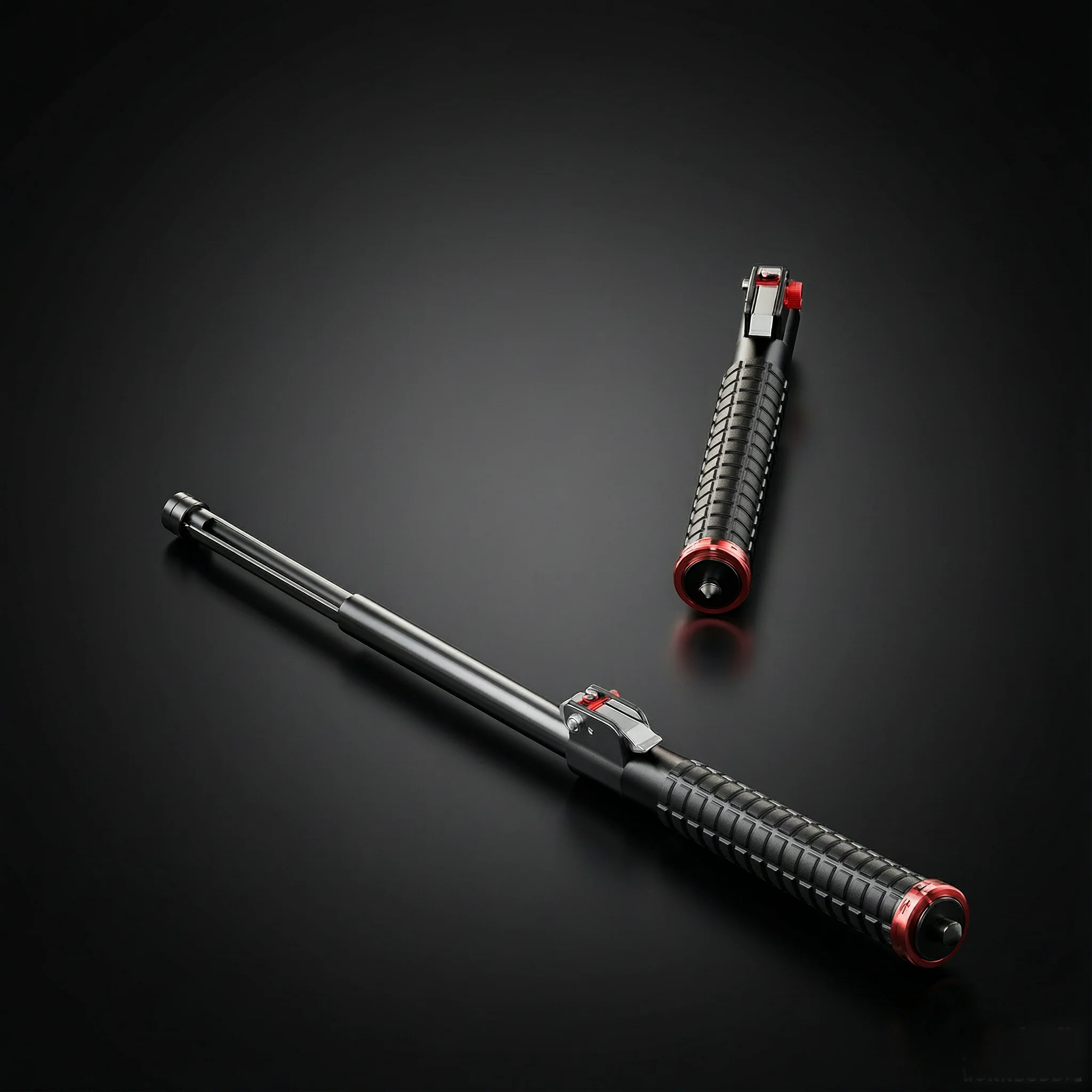
Search for baton legality and you will find two kinds of answers: a table of 50 states with checkmarks, or a forum post insisting "it is just a stick, they cannot charge you." Both are wrong in ways that matter. There is no federal statute regulating expandable batons, which means the answer is entirely state-level — and the state-level answer often turns on a word you would not expect.
The word that decides most cases: "billy"
State statutes rarely say "expandable baton." They say billy, blackjack, bludgeon, or club. Whether your baton falls inside one of those words is the whole question, and courts have answered it in ways that surprise buyers.
The clearest example is New York. In People v. Ocasio (2016), the defendant argued that a collapsible metal baton could not be a "billy" because the statute never mentioned collapsible or extendable versions. The Court of Appeals rejected that argument, holding that the only plausible reading of "billy" includes a collapsible metal baton, because the collapsing feature does not change "the essence, functionality, or inherent characteristics of the object." The court added that reading it otherwise would produce an absurd result, since a minor design change would let anyone escape liability.
A seller calling it a "defensive stick," "training baton" or "impact tool" changes nothing. Prosecutors and courts look at what the object is and how it functions, not what the packaging calls it.
Per se prohibited vs. intent-based: the distinction that decides charges
Most states divide weapons into two categories, and the difference is severe:
| Category | What the prosecutor must prove | Practical meaning |
|---|---|---|
| Per se prohibited | Only that you possessed it | Your intent, your clean record, and the fact that it never left your trunk are irrelevant. Possession is the crime. |
| Dangerous instrument | That you possessed it with intent to use it unlawfully | A baseball bat in your garage is fine; the same bat swung at someone is not. |
Where a state lists billies in the per se category, a baton does not get the benefit of the intent analysis. That is why "I only kept it in the car" is not a defense in New York — the possession itself is the Class A misdemeanor, with a maximum of 364 days and a $1,000 fine.
Three states to look at closely
New York — prohibited
Penal Law 265.01 covers billies as per se prohibited weapons, and Ocasio settled that a collapsible metal baton is one. Exceptions are narrow and aimed at law enforcement and specific licensed roles. New York City adds further restrictions on top of state law.
Massachusetts — restricted
Massachusetts defines "billy" broadly enough that telescoping metal batons fall inside it, and carry is restricted. In practice this means civilian carry is not a reliable option, and transport is subject to its own rules.
California — unsettled, treat as restricted
Penal Code 22210 lists batons among prohibited weapons. A federal district court decision in Fouts v. Bonta struck down part of California's scheme and the state appealed. While that works through the courts, the statute is still on the books. Anyone telling you the question is settled in either direction is overstating what is known.
Possession, open carry, concealed carry — three different questions
Even in states where a baton is not per se prohibited, the analysis does not end at "is it legal." Ask three separate questions:
- Can I possess it? At home, in a vehicle, in storage.
- Can I carry it? Openly, or concealed on my person. Some states require a permit for concealed carry of an impact weapon, and a handgun permit often does not cover it.
- Where is it prohibited regardless? Schools, courthouses, federal buildings, airports, and many private premises. These restrictions apply even where possession is otherwise lawful.
How to check your own state in 20 minutes
- Search your state legislature's site for the criminal code section on "prohibited weapons" or "deadly weapons." Look for the words billy, blackjack, bludgeon, club, baton.
- Read whether it is listed in the per se subsection or only appears under a general "dangerous instrument" definition. This is the single most important line in the statute.
- Check your city code. Municipal ordinances are frequently stricter than state law and are easy to miss.
- Check whether a permit applies and whether it covers "dangerous weapons" or only firearms.
- If it is ambiguous, ask a local attorney rather than a retailer or a forum. A one-hour consultation is cheaper than a misdemeanor.
Statutes and case law change, and the summary above is a starting point for your own verification, not a conclusion about your situation. We do not ship restricted items to states where they are prohibited — see our compliance page for the current list.
What to carry if a baton is not an option
In states where impact weapons are prohibited, the workable alternatives are the ones that are not classified as weapons at all: a high-output flashlight, a personal alarm, and a proper chemical spray where permitted. None of them require a permit, and the flashlight in particular solves the most common actual problem — not being able to see what is 20 metres away. If that is your situation, start with how many lumens you actually need.