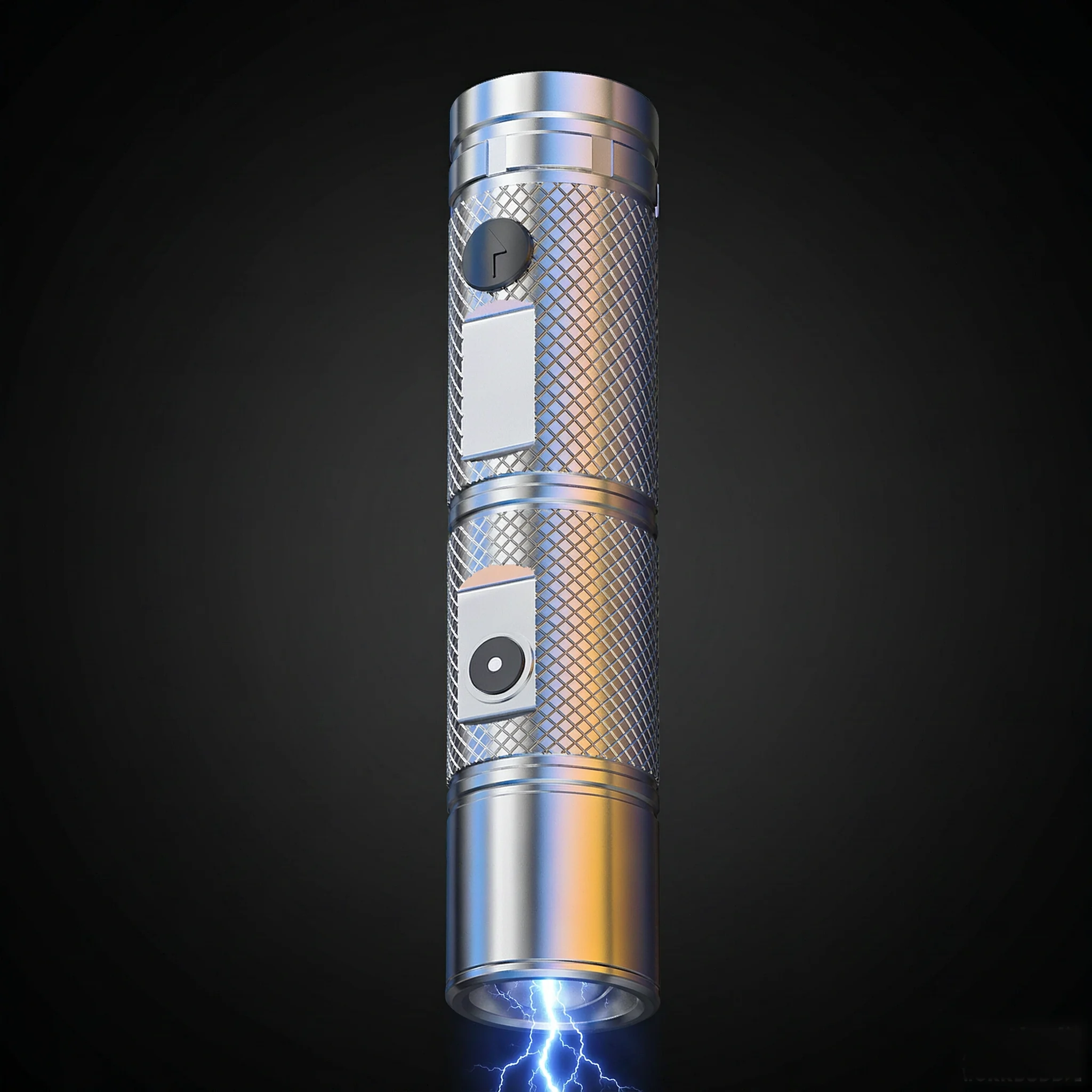
Every flashlight listing leads with lumens because lumens are easy to print and easy to compare. They are also the least useful number for deciding whether a light will do the job. Understanding one more spec — candela — will tell you more about a light than the entire marketing paragraph around it.
Lumens vs. candela, in one paragraph
Lumens are the total amount of light coming out of the front of the light, summed in all directions. Candela is how intense that light is in one direction — how tightly the reflector or lens focuses it. A light that produces 2,000 lumens and focuses them into a narrow beam will reach much further than a light producing 3,000 lumens spread across a wide flood.
Lumens tell you how much light is leaving. Candela tells you how far it arrives. Only one of those answers "can I see the far end of the parking lot."
Manufacturers report throw distance using the ANSI/PLATO FL1 standard, which is derived from candela: the distance at which the beam still delivers roughly the equivalent of moonlight on the target. When a listing says "350 m throw," that is a candela calculation, not a lumen one.
What each output range actually does
| Output | Realistic use | Limitation |
|---|---|---|
| 50–200 lm | Finding a keyhole, reading a map, walking a path without wrecking night vision | Nothing beyond arm's reach |
| 300–800 lm | Walking a dog, checking a driveway, roadside tyre change | Beam gets absorbed before 50 m |
| 1,000–2,500 lm | Identifying a figure at 30–60 m, searching a yard, vehicle emergencies | Needs a heat path; will step down on max |
| 3,000 lm+ | Search and rescue, wide-area work | Short peak, heavy battery draw, hot body |
Notice what the top row gives you that the others do not: a low mode. A single-mode 2,000-lumen light is a worse tool than a 2,000-lumen light with a 60-lumen low, because most of the time you are not trying to illuminate a field.
Four specs that matter more than the lumen number
1. Beam pattern
A tight hotspot with a dim spill is a thrower: good for identifying something far away, poor for walking because your feet are dark. A wide, even flood is the opposite. For general carry, a hotspot that covers roughly a 1-metre circle at 10 metres with usable spill around it is the most versatile compromise.
2. Sustainable output, not peak
Peak lumens are measured at switch-on from a cold light. Within a minute or two the driver reduces current to keep the LED from cooking itself. The honest question is not "how bright is the first second," it is "how bright is minute ten." A well-designed light will publish both.
3. Battery and cell type
High output requires high current. A 2,000-lumen light drawing from a small cell will either dim quickly or get hot fast. An 18650 or 21700 lithium-ion cell is the practical baseline for anything above 1,000 lumens. Buy lights with protected cells and a charger you control, and do not leave cheap unknown-brand cells charging unattended.
4. Switch behaviour
For a light you may use under stress, the tail switch matters more than the UI. A momentary switch (press for on, release for off) lets you flash-and-move without cycling through modes. Avoid lights where the only way to get maximum is a sequence of half-presses you will fumble with cold hands.
If you are thinking about it as a defensive tool
Light does two legitimate things in a tense situation, and neither involves hitting anyone:
- It identifies. Most ambiguous situations resolve once you can see what is 30 metres away — a person, a dog, a bag on the ground. Information beats reaction.
- It buys distance. A focused beam aimed at someone's eyes is disorienting for a moment, and that moment is long enough to move away and make noise.
A light is not a substitute for distance, awareness, or leaving. Check your state's rules before you describe any tool as a weapon — the classification is what determines whether carrying it is lawful, not the marketing wording. Our baton legality guide walks through that analysis.
The five-line buying check
- Candela or throw distance published, not just lumens.
- At least three modes including a low under 100 lumens.
- Stated runtime at a stated output — "up to 12 hours" without an output figure is meaningless.
- Water resistance rated to at least IPX4, ideally IPX8.
- Standard cell you can replace, not a proprietary battery pack that ends the light's life in two years.
For a car kit, prioritize a low mode and a beam that reaches 40–60 m over a headline lumen number. A light you can hold in your mouth while changing a tyre at 200 lumens is worth more than 3,000 lumens you cannot point anywhere useful. Pair it with a window breaker — the two failures in a roadside emergency are not seeing, and not getting out.